This article was co-authored by David Balkan and by staff writer, Christopher M. Osborne, PhD. David Balkan is a Professional Plumber, CEO of Balkan Sewer and Water Main Service, and President of Balkan Sewer and Drain Cleaning. As a hands-on owner of these companies for over 40 years, David is knowledgeable about water service lines, sewers, and drain line issues. David is a Committee Chairman of the Master Plumbers Council and has sat on the Executive Committee of the Sub Surface Plumbers Association of New York for over 30 years. His knowledge and solution-oriented approach contributed to Balkan Sewer and Water Main Service being the largest and most trusted service in New York City and the recipient of the 2017 Angie’s List Super Service Award.
If you hear a “drip, drip” from underneath the kitchen sink when it’s full of dirty dishes and water, there’s a good chance you have a leaky sink drain (often called a sink strainer). The sink strainer is the metal, funnel-shaped contraption that pressure seals to the sink from above and below, and it will eventually either spring a leak or get so scratched and discolored that you’ll want to replace it. Luckily, with the right tools and some elbow grease, you can remove all but the most stubborn rusted-on sink drains yourself — and even install a new one without calling a plumber!

This article was co-authored by David Balkan and by staff writer, Christopher M. Osborne, PhD. David Balkan is a Professional Plumber, CEO of Balkan Sewer and Water Main Service, and President of Balkan Sewer and Drain Cleaning. As a hands-on owner of these companies for over 40 years, David is knowledgeable about water service lines, sewers, and drain line issues. David is a Committee Chairman of the Master Plumbers Council and has sat on the Executive Committee of the Sub Surface Plumbers Association of New York for over 30 years. His knowledge and solution-oriented approach contributed to Balkan Sewer and Water Main Service being the largest and most trusted service in New York City and the recipient of the 2017 Angie’s List Super Service Award. This article has been viewed 193, 873 times.
How To Unclog A Double Kitchen Sink With Standing Water?
To remove a kitchen sink drain, all you’ll need is a wrench, a screwdriver, and a pair of needle-nosed pliers. The first thing to do is loosen the coupling nut connecting the strainer to the drain pipe, which you can usually do by hand. If the nut is very tight, hold the strainer in place from above with the pliers while you loosen it. If you see screws holding your strainer in place, remove them with the screwdriver before loosening the locknut by hand. For a locknut with no screws, you’ll need to use a wrench to loosen it by turning it counterclockwise. Then, you should be able to wiggle the strainer loose and push it out of the sink. Finish by cleaning any gunk or putty from around the hole where the drain was fitted. For tips on how to install a new kitchen sink drain, read on!Directly beneath the drain outlet of every kitchen sink and every bathroom lavatory is a trap. This element is vital not only to the proper functioning of the drainage system but also to your health and safety. Each drain trap contains and maintains a plug of water within its curved section that seals against the entrance of harmful sewer gases. If the drap trap leaks, this water barrier may disappear and create a hazardous situation.
All drain traps must be kept in proper working order. Restrictions and clogging are immediately noticeable because the drainage flow is slowed or stopped. Clearing the blockage takes care of the problem. Leakage or seepage can often go undetected for a while, so check your traps from time to time and make quick repairs if anything seems wrong.
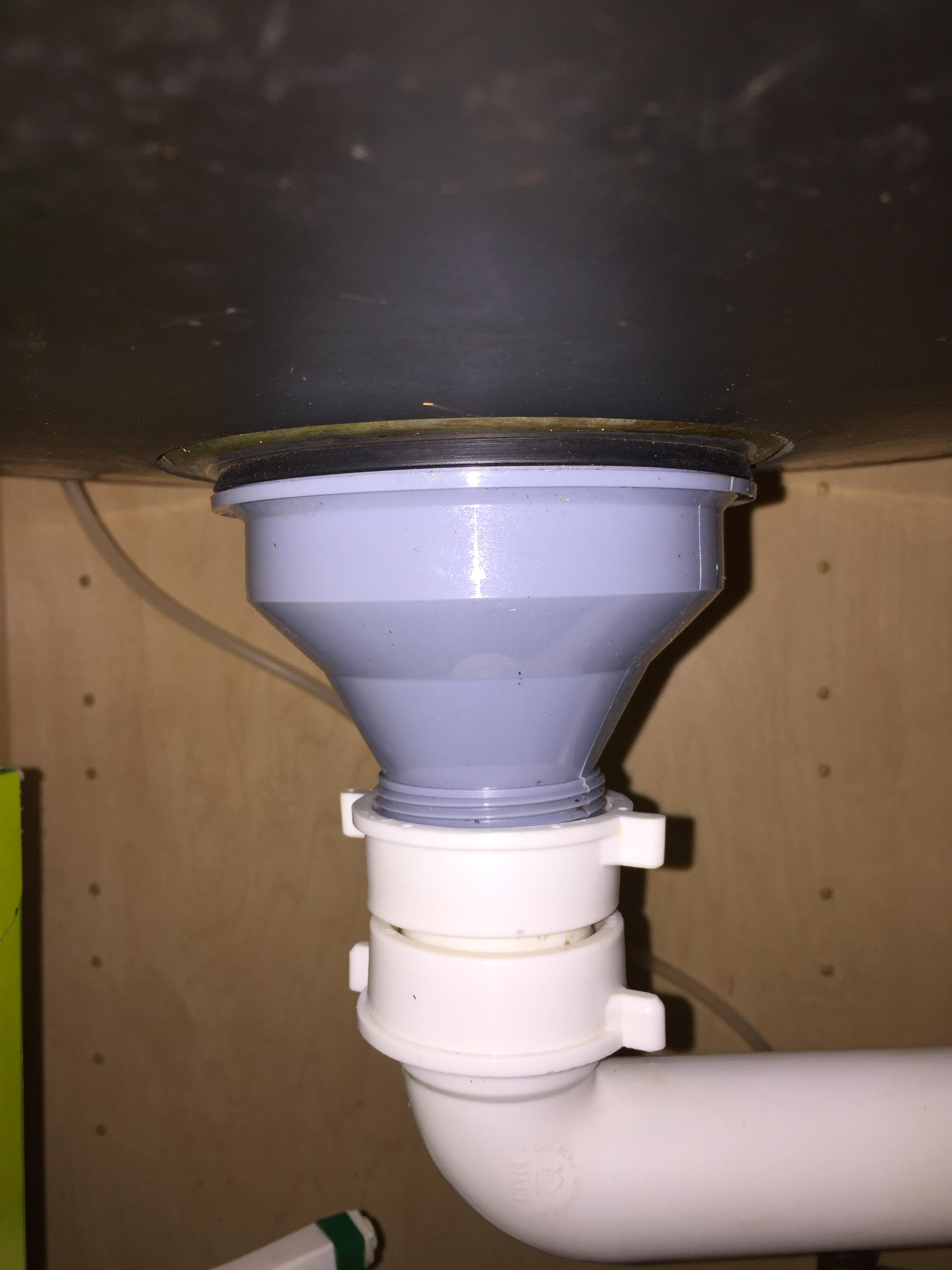
Drain trap assemblies have several parts. The short piece of pipe that extends downward from the drain outlet flange in the sink or lavatory is called the tailpiece. The curved section of pipe connected to the tailpiece is the trap itself. The trap may be either one piece or two coupled sections. The piece of pipe extending from the end of the trap to the drainpipe outlet in the wall or floor is the drain extension. All of these pieces may be made of rather thin metal that is subject to corrosion, seal failure, and mechanical damage. Damage can also result from reaming with a plumbers' auger. Whatever the reason for failure, a malfunctioning trap should be repaired immediately.
House Sink Trap Care, Repair, And Maintenance
Sometimes the problem is simply that the slip nuts holding the drain trap assembly to the drain and the drainpipe have loosened. Tightening them may solve the problem. But if the metal has corroded through, if the slip-nut threads are damaged, or if other damage has occurred, the only solution is replacement.
Drain trap assemblies and parts to fit just about any possible installation requirement are readily available at most hardware and all plumbing supply stores. Chrome-plated thinwall brass traps are popular, especially where appearance is important. Polypropylene (PP) plastic traps, notable for their ruggedness and longevity, will outperform all other types. ABS plastic traps are also in use, but they become deformed and eventually fail when forced to handle frequent passage of boiling water and caustic household chemicals. In addition, they may not be allowed by your local plumbing code. Ask the plumbing clerk at your local building materials retailer for recommendations.

Whatever the material, there are typically two trap diameters: 11/2-inch traps for kitchen sinks and 11/4-inch traps for lavatories. Take the old trap with you when you buy the new one; if possible, also take the old tailpiece and drain extension. In most cases, trap replacement is simple. Here's how:
How Do You Unclog A Drain?
Step 1: If trap is equipped with cleanout plug on bottom of curved section, remove plug with wrench and let water in trap drain into bucket. Otherwise, unscrew slip nuts and slide them out of the way.
Step 2: If trap is a swivel type, curved trap section(s) will come free. However, keep trap upright as you remove it, and pour water out after part is free. If trap is fixed and does not swivel, remove tailpiece slip nut at drain flange and slip nut at top of trap. Shove tailpiece down into trap itself, then twist trap clockwise until you can drain water in trap. Pull tailpiece free, and unscrew trap from drain extension or drainpipe.

Step 3: Buy drain trap of proper diameter, new tailpiece, drain extension, or other fittings, as necessary. A swivel trap is the easiest to work with because it can be easily adjusted for angled or misaligned drainpipe/fixture installations. A clean-out plug on a trap is handy so trap can be cleaned out without removing it.
How To Change A Basin Waste
Step 4: Replace parts in appropriate order, making sure you have slip nuts and compression seals, or large washers, lined up on the proper pipe sections. Couple parts together loosely with slip nuts, make final adjustments for correct pipe alignment, and tighten nuts snugly but not too tight. Plumbers' joint tape or compound is not usually necessary, but you can use either.
Step 5: Run water into new trap immediately, both to check for leaks and to fill trap with water to provide that all-important barrier against sewer gases.

As you can see from the tips in this article, a clogged drain does not necessarily mean a huge plumbing bill. Follow the steps detailed on these pages and you may just unclog that drain all on your own.If the connections between your sewer pipe and the U-shape pipe are loose and can’t be fixed by tightening the connecting nuts, you’ll have to install a new p-trap assembly. (i.e. P-trap replacement.) Corrosion and loose joints are the common issues with p-trap and, if they persist, you need to replace the drain trap ASAP to avoid water damage.
Simple Steps For P Trap Replacement To Your Kitchen Sink
Wondering how to replace a drain trap? Don’t fret; you’re at the right place. This article will guide you to know how to connect p-trap to wall drain step-by-step. You only need to know the P-trap anatomy and how it works, and you’re set to go.
A drain trap is also known as a P-trap. The name P-trap is derived from its appearance- a looping shape that looks like the letter “P“. Every time you use the sink, a small amount of standing water remains trapped at the end of the trap. The water seals the drain’s opening and prevents sewer gases from seeping through the sewer pipes from the sewer system to your house. Also, look at the P-trap installation diagram below to understand how it works.
Also, the drain trap acts as a recovery point for small valuables like rings or necklaces when they go down the drain through the sink. Instead of those objects getting washed away into the main drain, they remain in the Ps-trap. It’s also through the trap where you can quickly clear clogs in the branch drain attached to the wall or from the trap

0 Comments
Posting Komentar