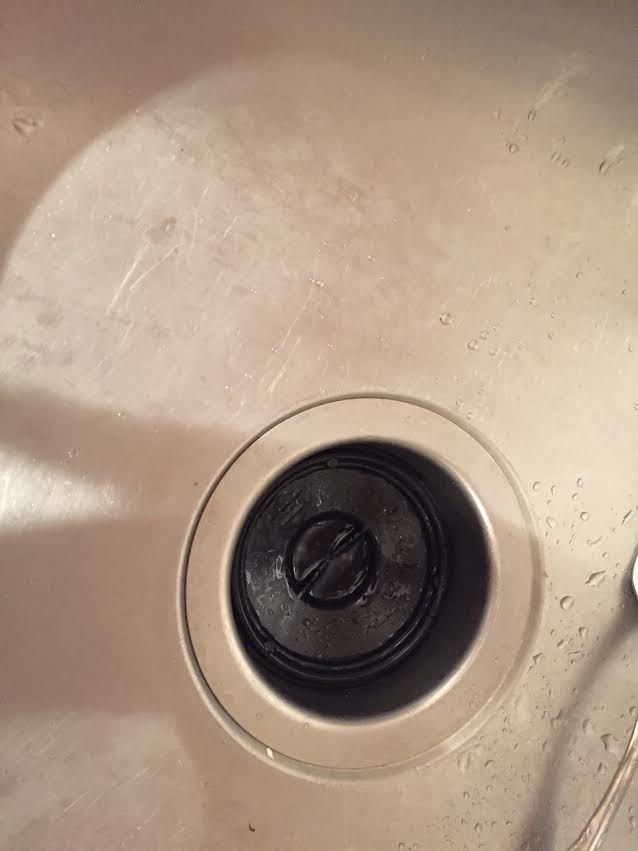
As you can see in the picture, in my infinite wisdom, I managed to block the kitchen sink with the stopper by placing it upside down in the sink, now I can't take the stopper out... Oops. Any suggestions on how I could take the stopper out, so I could use the sink again?
The stopper has a vertical wall running through its center roughly 1 cm tall, I was thinking I could pull the darn thing out by latching onto this surface with a grip of some kind. I couldnt do this with my fingers alone.
Fill void with water and use a toilet plunger. Failing that, you're going to need to drill it and insert a screw.
Stainless Steel Sink Waste Waste Trap Sink Trap Basin Trap Sink Drain Plug Lubang Paip Air Mangkuk Sinki Dapur
Nail clippers, for anyone reading this in future. It just happened to me with water in the sink. I spent an hour unsuccessfully trying to pry it out with a butter knife. I couldn't find a plunger or pliers, so I used the best thing at my disposal and thankfully it worked. Just open your clippers and rap them around the rubber ridge in the middle of your plug like you're going to cut a nail. Then press the clippers and pull up. It pops out EZPZ.
Happened to me yesterday with a mason jar lid. I filled the other sink and quickly let the water out. The pressure dislodged the obstruction.
If the stopper is flat and will not pop up, put a drop of super glue on the corner of a note card and glue the card to the stopper. After a few seconds, lift the card and it will pull up the stopper. I just did this and it worked like a charm. When I pulled the card off the stopper, the tiny bit of paper residue was easily scraped off.
Cheap Stainless Steel Kitchen Sink Pop Up Core Drain Sink Dishwasher Filter Basket Wash Basin Water Blocking Cover Leaking Plug Plate
If there is not too much plumbing in the way, you could undo the drain pipe under the sink so that you can
It happened with me too, just within a week of arrival in the USA. An online tip to use a butter knife on the side of the snapped-in-lid to release the vacuum worked for me. Yes, first taking out the collected water in the sink to see the lid clearly was essential to this process.
Highly active question. Earn 10 reputation (not counting the association bonus) in order to answer this question. The reputation requirement helps protect this question from spam and non-answer activity.This article was co-authored by David Balkan and by staff writer, Christopher M. Osborne, PhD. David Balkan is a Professional Plumber, CEO of Balkan Sewer and Water Main Service, and President of Balkan Sewer and Drain Cleaning. As a hands-on owner of these companies for over 40 years, David is knowledgeable about water service lines, sewers, and drain line issues. David is a Committee Chairman of the Master Plumbers Council and has sat on the Executive Committee of the Sub Surface Plumbers Association of New York for over 30 years. His knowledge and solution-oriented approach contributed to Balkan Sewer and Water Main Service being the largest and most trusted service in New York City and the recipient of the 2017 Angie’s List Super Service Award.
How To Remove Kitchen Sink Odours In 'five Minutes' Using 'fantastic' Household Item
If you hear a “drip, drip” from underneath the kitchen sink when it’s full of dirty dishes and water, there’s a good chance you have a leaky sink drain (often called a sink strainer). The sink strainer is the metal, funnel-shaped contraption that pressure seals to the sink from above and below, and it will eventually either spring a leak or get so scratched and discolored that you’ll want to replace it. Luckily, with the right tools and some elbow grease, you can remove all but the most stubborn rusted-on sink drains yourself — and even install a new one without calling a plumber!

This article was co-authored by David Balkan and by staff writer, Christopher M. Osborne, PhD. David Balkan is a Professional Plumber, CEO of Balkan Sewer and Water Main Service, and President of Balkan Sewer and Drain Cleaning. As a hands-on owner of these companies for over 40 years, David is knowledgeable about water service lines, sewers, and drain line issues. David is a Committee Chairman of the Master Plumbers Council and has sat on the Executive Committee of the Sub Surface Plumbers Association of New York for over 30 years. His knowledge and solution-oriented approach contributed to Balkan Sewer and Water Main Service being the largest and most trusted service in New York City and the recipient of the 2017 Angie’s List Super Service Award. This article has been viewed 218, 860 times.
To remove a kitchen sink drain, all you’ll need is a wrench, a screwdriver, and a pair of needle-nosed pliers. The first thing to do is loosen the coupling nut connecting the strainer to the drain pipe, which you can usually do by hand. If the nut is very tight, hold the strainer in place from above with the pliers while you loosen it. If you see screws holding your strainer in place, remove them with the screwdriver before loosening the locknut by hand. For a locknut with no screws, you’ll need to use a wrench to loosen it by turning it counterclockwise. Then, you should be able to wiggle the strainer loose and push it out of the sink. Finish by cleaning any gunk or putty from around the hole where the drain was fitted. For tips on how to install a new kitchen sink drain, read on!Removing a sink flange to replace or repair it is a reasonably straightforward DIY task that you can accomplish without any expertise. However, residue and rust buildup can often turn an easy plumbing job into a frustrating experience.
How To Remove 4 Types Of Sink Stoppers In 3 4 Steps (2024)
Fortunately, there are some simple ways to remove a sink flange, even if it's firmly stuck in the assembly. Use these step-by-step instructions to remove a sink drain flange.
Before you begin, empty everything from underneath the sink and place a cushion or two on the floor for comfort. It's also worth switching off the water supply to the faucet so that you don't get a nasty surprise if someone turns the tap on while you're working under the sink.

The coupling nut is a large ring-shaped nut that joins the flange basket to the drain pipe. Grasp it firmly with a set of slip-joint pliers and twist it to the left to loosen it. If it doesn't budge, try turning it in the opposite direction. Doing this can break any residue or rust that's jamming the nut, letting you unscrew it more easily. Loosen it until you can remove it from the threads.
How Do I Remove Kitchen Sink Drainer Basket Without A Visible Lock Nut?
Using your slip-joint pliers, twist the locknut between the flange assembly and the bottom of the sink to remove it. If the flange is rusty or caked with residue, this may cause it to spin.
Allowing the flange to spin while you loosen the locknut could lead to damage, so it's important to hold it still while you work. You can do this by inserting the handles of a pair of pliers into two of the holes in the drain basket. Place a screwdriver or other rigid tool between the handles, and ask a helper to hold it in place to stop it from turning.
Finally, you can use a utility knife to cut away any hardened plumber's putty holding the flange in place and gently pry the flange upwards. Once you've chipped away any putty causing the flange to stick, you should be able to pull it out by hand.

Kitchen Sink Stopper Stopper Bathroom Tub Tub Rubber Stopper For Kitchen Sink Drains Accessories
Rust is one of the most common reasons people find it difficult to remove their old sink flange. One of the easiest and most effective ways to break down the rust is to spray the threading thoroughly with silicone lubricant and leave it to soften. The package should tell you how long you need to let it sit. If you still can't loosen it, try tightening the nut instead. While it may sound counterintuitive, this can break the stubborn rust and solve the issue.
If lubricant doesn't work or the issue is compounded by a thick layer of putty holding the flange in place, you may need to apply a bit more force to get it out. Place a block of wood under the sink against the bottom of the flange and hit the wood firmly with a hammer. The sudden force should be enough to break any stubborn rust or putty and loosen the flange.The kitchen sink basket strainer plug for our double bowl sink had been leaking for a couple of months and it was driving me batty. It made washing up difficult because the water would drain away while washing up the pots and pans. Even more frustrating was when both plugs stopped sealing, so we couldn’t swap the plugs. It’s one of those things you don’t realise is annoying until you have to fill the sink and you can’t. But you soon forget until you need to fill the sink again!
The reason our sink plugs wouldn’t hold water was because the

0 Comments
Posting Komentar